They Saw a Sunset Photo. You Saw the Whole Year That Led Up to It.
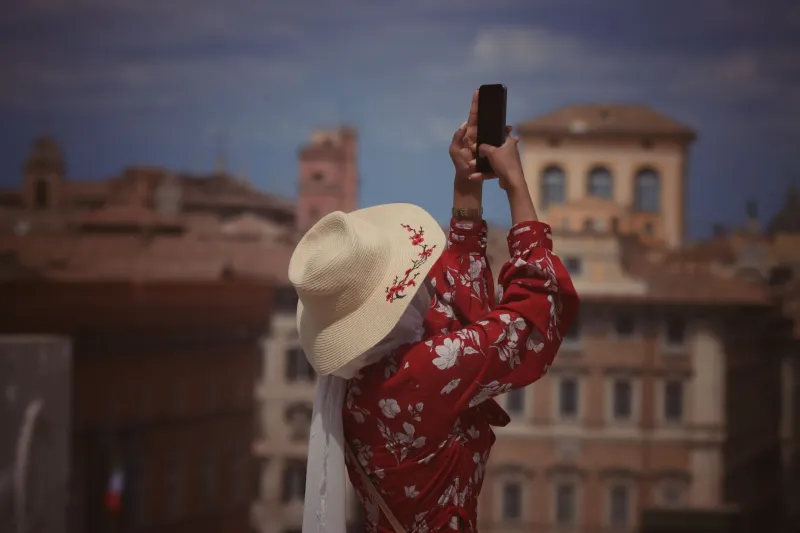
You're sitting on a terrace somewhere in southern Portugal, or maybe a rooftop in Oaxaca, and the light hits just right. You take the photo. You post it. And within minutes, your aunt replies with a flame emoji and your dad types, "Still traveling huh? When are you coming home?"
And just like that, the whole moment deflates a little.
It's not that they mean harm. It's not even that they're wrong to ask. But there's a particular kind of loneliness that settles in when you realize the people who love you most are looking at a completely different image than the one you took.
The Photo Is Never Really the Point
Here's the thing about travel photography that nobody explains to your family back home: the photo is almost never about the place. It's about the version of yourself standing in front of it.
That sunset in Portugal? You took it after six months of white-knuckling a new language, rebuilding your social life from scratch, and finally — finally — arriving at something that felt like peace. Your family sees a pretty sky over water. You see the evidence that you survived something hard and came out the other side.
That's not a gap that a caption can close.
Most travelers figure this out slowly, usually after one too many phone calls where they try to explain why a particular Tuesday in a foreign city felt more alive than any week back home — and they're met with polite, slightly confused silence. The experience of long-term travel is genuinely hard to translate, not because it's exotic, but because it's internal. The transformation happens inside you, and photos only capture the backdrop.
The Generational Layer Makes It Messier
For a lot of Americans, especially those whose parents or grandparents came of age in the mid-20th century, international travel was either a luxury or a military deployment. It wasn't something you did for personal growth. It wasn't a lifestyle. It was a trip — a thing with a start date and an end date, a souvenir, and a slide show.
So when you tell your parents you've been living in Colombia for eight months and you're not sure when you're coming back, they're not processing that through the same lens as, say, a friend who's done the same. They're processing it through a framework where extended time abroad means either you're running from something, you're lost, or you've joined something suspicious.
This isn't a criticism of that generation — it's just context. Their mental model of "going abroad" doesn't have a slot for "I quit my job, rented a place in Medellín, and I'm figuring out what kind of life I actually want." That sentence sounds like a cry for help to someone who's never considered it as an option.
And the photos you post? They get filtered through that same framework. A picture of you laughing with strangers at a bar in Bangkok reads as "reckless" to someone who's never backpacked. A photo of you working from a café in Lisbon reads as "playing pretend." You know the reality — the discipline it takes, the community you've built, the intentionality behind it all. They see a screen.
The Emotional Labor of Translation
For a while, most travelers try. They try to explain. They send voice memos. They call on Sundays and describe the neighborhood market, the way the language sounds, the small kindnesses of strangers. They want to share it. They want their people to understand why this matters.
But translation is exhausting, especially when you're also trying to actually live the experience you're translating. At some point, a lot of long-term travelers quietly stop trying to make their families understand — not out of resentment, but out of self-preservation. You can't keep interrupting your own life to narrate it for an audience that's watching a different show.
This is one of the least-discussed forms of reverse culture shock: it doesn't only hit when you land back in the US. It hits in real time, on a Tuesday, when you post something that felt significant and it gets three likes and a "be safe out there" from your cousin.
What Your Family Is Actually Seeing
Here's a more charitable read on the disconnect, and honestly, it's worth sitting with.
Your family isn't dismissing your experience. They're worried about you, in the specific way that people worry about someone they love who seems to be moving further away — physically and otherwise. The comments that feel reductive ("still traveling?" "when are you settling down?") are often just anxiety wearing a casual outfit.
And the photos? They're looking at them and seeing you — their kid, their sibling, their friend — in places that feel very far away and slightly unknowable. That's actually kind of painful for them. The sunset is beautiful, sure. But what they're really looking at is proof that you're somewhere they've never been and might never go.
That's worth acknowledging, even when it's frustrating.
Finding Peace With the Gap
You're probably not going to fully bridge this divide, and that's okay. Some experiences aren't meant to be fully shared — they're meant to be fully lived. The people who will understand your travel photos the most completely are the ones who've taken similar photos in similar moments. That's why the friendships you make abroad often feel so immediate and deep: you're all working from the same emotional vocabulary.
But your family back home loves you in a different language. They're not wrong for not getting it. You're not wrong for wishing they did.
Maybe the move is to stop trying to make the photos do the work. Call your mom about something other than travel. Let your dad talk about his stuff. Keep some of the experience sacred and untranslated — not because it's secret, but because it belongs to you.
The sunset will still mean everything it meant. It just doesn't need a caption that explains it.
And honestly? That might be the most grown-up thing travel teaches you: not every beautiful thing needs to be understood by everyone. Some of it is just yours.